
Build visibility across Google AI, ChatGPT, Claude, and Perplexity.
Dooriax strengthens the shared foundations of AI-assisted search: crawlable pages, accurate local entities, useful service information, official search-crawler access, reputable third-party references, and measurable organic demand.
- Google, Bing, and AI search index readiness
- Current AI search crawlers allowed
- Clear entities, useful answers, and real authority
AI search optimization improves a business's eligibility to be retrieved or cited by Google AI features, Gemini, ChatGPT, Claude, Perplexity, Bing, and Copilot. The work combines durable SEO, current crawler access, accurate business entities, useful pages, original expertise, trusted third-party references, and measurement.
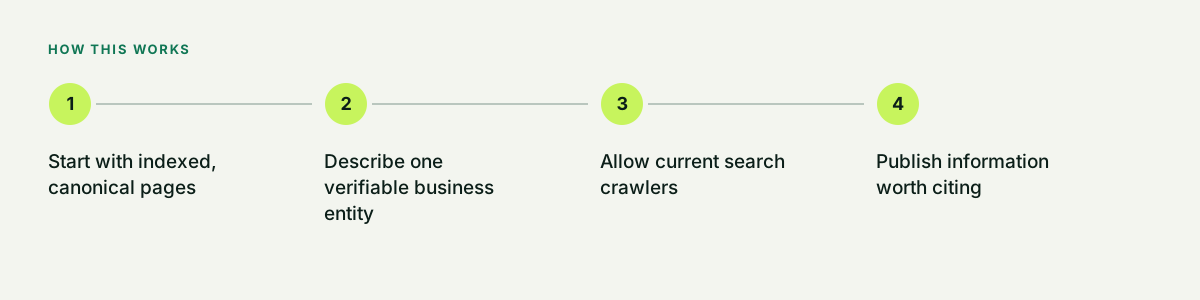
Start with indexed, canonical pages
Google AI features and Gemini grounding depend on Google's search and retrieval systems, while Copilot uses Bing. Priority pages need real status codes, canonical URLs, crawlable links, accurate sitemaps, useful titles, and complete mobile content.
- Google Search Console
- Bing Webmaster Tools
- Canonical URL review
- IndexNow for meaningful updates
Describe one verifiable business entity
The website and official profiles should agree on the business name, website, phone, location or service area, services, and description. Structured data can reinforce visible facts but cannot replace them.
- Organization and service schema
- Consistent social profiles
- Accurate business categories
- No fabricated locations or credentials
Allow current search crawlers
ChatGPT search uses OAI-SearchBot, Claude search uses Claude-SearchBot and Claude-User, and Perplexity recommends allowing PerplexityBot. Those controls are separate from some model-training crawlers. Robots access improves eligibility but does not create authority or guarantee a citation.
- OAI-SearchBot
- Claude-SearchBot and Claude-User
- PerplexityBot
- Googlebot, Google-Extended, and Bingbot
Publish information worth citing
AI answers need sources that explain a decision clearly. Useful material includes original process guidance, documented case studies, named expertise, current service information, direct answers, and links to primary sources.
- Direct answer sections
- Expert-reviewed guidance
- Verifiable proof assets
- Clear update dates and sources
Measure visibility without inventing certainty
Dooriax reviews organic queries, landing pages, generative-AI visibility where Search Console provides it, Bing crawl and IndexNow signals, referral traffic, and qualified conversions. Eligibility never guarantees selection or ranking.
- Search and AI impressions
- Branded entity queries
- Cited landing pages
- Qualified calls and forms
Sources used for this guidance.
Common questions.
Direct answers about fit, process, limits, and next steps.
Can Dooriax guarantee an AI citation or recommendation?
No. Google, OpenAI, Anthropic, Perplexity, Microsoft, and other platforms decide what to crawl, index, retrieve, cite, and recommend. Dooriax improves eligibility, clarity, local entity signals, and authority without promising selection.
Does AI search require hidden text or a separate AI version of every page?
No. The visible page should serve people first and remain crawlable, accurate, well structured, and consistent across devices. Machine-readable files can support other agents but do not replace public content or ordinary SEO.
Is allowing an AI crawler enough to appear in answers?
No. Crawler access only permits discovery or retrieval. The site still needs useful relevant content, an accurate entity, traditional search visibility, verifiable proof, third-party authority, and enough time for each platform to process changes.
Build the next useful part of the system.
Bring the current tools, operating bottleneck, market, timing, and outcome. Dooriax will start with the facts.